
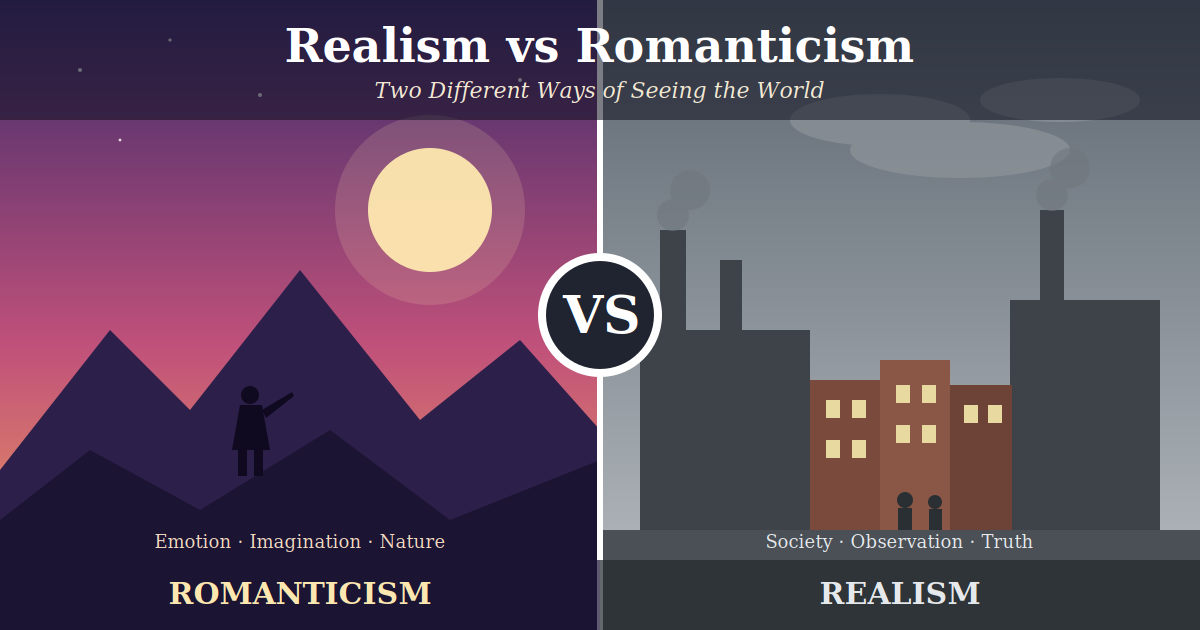
Realism vs Romanticism: Two Different Ways to See the World
Introduction and Background
Literature has always reflected the beliefs, values and experiences of society. Various literary movements have arisen over time, each offering a unique perspective on the world. Romanticism and Realism were two of the most influential movements of the nineteenth century. The Realism vs Romanticism debate continues to shape the way we read literature. Romanticism was focused on emotion, imagination and the beauty of nature, while Realism was more concerned with everyday life, social issues and a truthful depiction of reality. Although they were different, both of these movements had an important role in the creation of contemporary literature and continue to influence writers today.
The Rise of Romanticism
Romanticism was a movement that began in the late eighteenth century and flourished in the early nineteenth century. It developed partly in reaction to the Industrial Revolution and the Enlightenment, which had stressed science, logic and reason. Romantic writers felt that society was becoming too obsessed with machinery and rational thought, and there was little place for emotion, creativity and individuality.
For the Romantics, feelings were a powerful source of knowledge and understanding. They encouraged people to believe in their feelings and to delight in the beauty of the natural world. Nature was not merely a physical environment for Romantic writers; it was a source of inspiration, comfort, and spiritual connection.
The movement placed great emphasis on personal freedom and self-expression. Romantic characters are often dreamers, rebels, adventurers or heroes fighting social restrictions. Their journeys are often marked by exploration, discovery, and emotional growth.
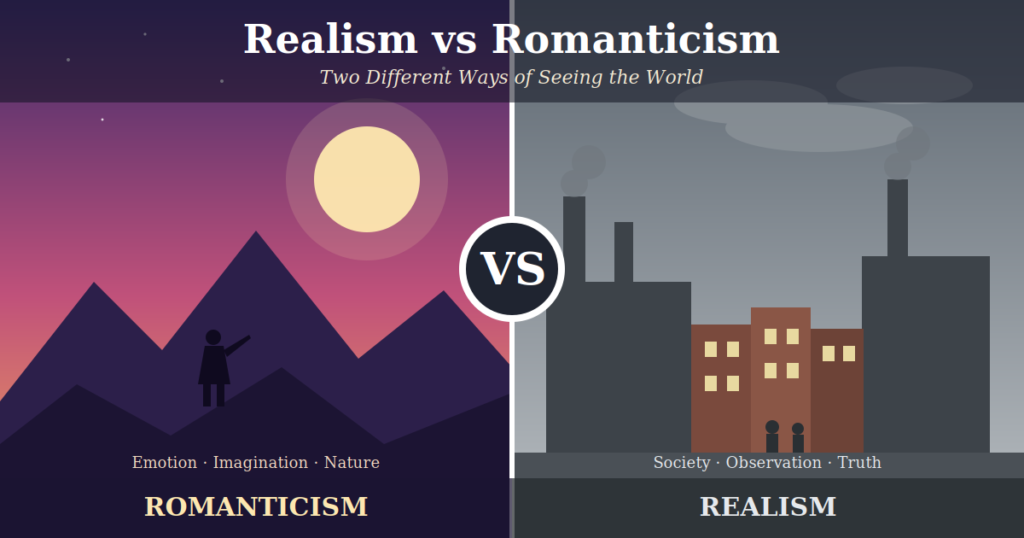
Romanticism: Key Characteristics
One of the hallmarks of Romanticism is its stress on imagination. Romantic writers took their readers to fantastical worlds, filled with strong imagery and descriptive language. In romantic literature, supernatural elements, mysteries and dramatic events are common.
Nature is also a core component. Mountains, forests, rivers, and storms are often emblems of beauty, power, and wonder. For the Romantic poets nature was a teacher, inspiring deep thought and healing emotion.
Another important feature is the emphasis on individual experience. The Romantic writers were interested in the personal thoughts, feelings and desires of individuals, not in society as a whole. Love, passion, freedom, heroism, these are usually the major themes.
Some famous Romantic writers include William Wordsworth, Samuel Taylor Coleridge, John Keats, Percy Bysshe Shelley and Lord Byron. Their poetry often celebrates the imagination and the emotional bond between human beings and nature.
The Realism Revolution
By the middle of the nineteenth century, many writers began to question the Romantic idealisation of life. They believed literature should reflect the world as it is, not as people wish it to be. This gave birth to Realism.
Realism came about in a time of fast social change. Industrialisation, urban growth and political reform transformed society, creating new opportunities but also presenting major challenges. Realist writers sought to explore these changes and to give voice to the experience of ordinary people.
Realists were preoccupied with accuracy and observation, unlike the Romantic writers. They wrote thoughtfully of everyday places, believable people and realistic happenings. They were not intended to entertain the reader with fantasy, but rather to stimulate thought about society.
Characteristics of Realism
Realist literature concerns itself with ordinary life and everyday experience. The characters are usually realistic people with strengths, weaknesses, ambitions and faults. Readers are introduced to workers, teachers, merchants, families, and the middle and working classes rather than heroes and adventurers.
Another important feature of Realism is concern with social problems. Realist writers often focused on issues of poverty, inequality, education, gender roles and working conditions. They brought out the problems of society in their stories and asked the reader to think over them.
Objective, detailed descriptions were also favoured by realists. Their writing style is typically direct and factual, avoiding excessive sentimentality or dramatic exaggeration. That’s why their works tend to be authentic and relatable.
Some important writers of Realism are Charles Dickens, George Eliot, Gustave Flaubert, Leo Tolstoy and Thomas Hardy. Complex characters and realistic situations in their novels still resonate with readers today.
Realism vs Romanticism: Key Differences
The Realism vs Romanticism dichotomy is often perceived as a confrontation, but the two movements are part of the same general historical epoch and offer very different views of life.
Romanticism is about dreams and emotions and ideal possibilities. It celebrates imagination and encourages the reader to see beyond the confines of everyday life. Romantic writers often paint nature as beautiful and inspiring. Their characters often embark on amazing journeys.
Realism, by contrast, is about reality, practicality, social truth. Realist writers believe that literature should describe everyday life and present a true picture of society. Their characters tend to be everyday people faced with real problems and tough choices.
Realism is about understanding and being accurate. Romanticism is about inspiration and emotional depth. One movement looks to imagination; the other movement looks to observation.
Commonalities between Romanticism and Realism
Realism vs Romanticism is often presented as a contrast, but the two movements have some important similarities. Both sought to explore human experience, to understand the world around them. Both movements generated influential works of literature that are studied to this day.
Writers in the Romantic and Realist periods also responded to the social and cultural changes of their day. The two movements, while differing in the way they approached these changes, represented the concerns, values, and aspirations of nineteenth-century society.
Realism vs Romanticism Today
The influence of Realism vs Romanticism can still be seen in literature, films and media today. Fantasy novels, inspirational poetry and adventure stories are often imbued with Romantic ideals, while the modern drama, documentary and social novel tend to rely on Realist traditions.
Many modern works use both approaches. A novel may deal with real social problems. Or it may deal with the feelings and aspirations of the characters. Realism and imagination show the mixture of these two movements, which are still relevant in the twenty-first century.
Want Your Writing to Feel Real and Vivid?
Great writers know when to paint a dreamy scene, and when to keep the details honest, and examiners reward that ability. See what’s new in AQA GCSE English Language Paper 1 (2026) and learn how to make these ideas work for you to get higher marks.
Conclusion
Realism and Romanticism are two distinct but equally valid approaches to literature. Romanticism celebrates feeling and fancy, beauty in nature and inspires readers to dream and to think about the possibilities of human experience. Realism, in contrast, presents a real picture of everyday life. It helps the readers to understand society and human behaviour better. Together, these movements have created literary history and helped us better understand the world. By studying Realism vs Romanticism, readers may gain a greater understanding of how literature can mirror reality and simultaneously spark imagination and instill hope.
